Let's build this article the way we build a site. Every concept we explain, you'll feel in real time as you read. When we talk about typography, the typography shifts in front of you. When we mention scroll-driven animations, the scroll you just performed produced one. When we reach the before-and-after, you can drag the slider and see.
This isn't a trick. It's proof. Most design essays explain concepts with dead screenshots and words that float into the air without ever landing anywhere. This one won't. If Autonoma ships cinematic sites, then the least this article can do is be one.
01 · The First FoldYou have 3 seconds.
That's the average time a visitor gives a website before deciding whether to stay or leave. Three seconds. Less than the time it took you to read this paragraph.
In those first three seconds, the visitor isn't reading — they're feeling. They feel whether the site looks expensive or cheap, serious or amateur, current or stuck in 2015. The judgement is visual, emotional, pre-rational. And it's almost impossible to reverse once it's formed.
The first fold — the part of the site visible without scrolling — has exactly one job: convince the visitor to stay another ten seconds.
Principles of a cinematic first fold
- Breathe. Generous negative space. Luxury doesn't live in the elements; it lives in the room between them.
- A single point of focus. The eye needs somewhere to land. A hero with five things competing has none.
- Slow motion. A twenty-second zoom, light shifting softly, particles falling. Fast motion reads as anxiety. Slow motion reads as confidence.
- Typography in the flesh. Large serif, subtle sans-serif. Never both shouting.
02 · TypographyAn emotional choice.
Typography isn't a technical decision. Every typeface carries an implicit promise — before the reader has parsed a single word. Test it yourself: click the options below and watch the same text transform.
Each one communicates something before you read:
- Large serif = established, authority, legacy
- Thin sans-serif = modern, tech, minimal
- Editorial display = intellectual, confident, literary
- Mono tech = code, precision, startup
On a cinematic site we rarely use just one. We use two — one for headlines, one for body — and we choose with rigour:
- Contrast, not duplication. Serif with sans-serif. Never two similar serifs.
- A musical scale. Sizes related by ratios (1.5×, 1.618×, 2×), not arbitrary numbers.
- Hierarchical weight. Bold only for what genuinely matters.
Look at the headings of this article. Cormorant Garamond (classic serif, 700 weight) for titles; Inter (modern sans-serif, 400 weight) for the body. The tension between the two is deliberate. It creates hierarchy without needing colour.
03 · Colour and LightThree colours. Never more.
Colour is the second most powerful visual differentiator (the first is typography). But colour handled badly destroys a site in seconds.
Hover (or tap) on the swatches below. The card itself responds to the palette you pick.
Rules for premium palettes
- Never use more than 3 colours — one primary, one neutral, one accent. Exceptions are rare and deliberate.
- Neutral isn't white — it's cream. Off-white. Stone.
#FAFAFAinstead of#FFFFFFchanges the entire perception. - Light needs shadow. An all-light site reads as flat. An all-dark site reads as heavy. Premium is always light with depth — subtle shadows, directional gradients.
- Gold solves 80% of cases. Gold gradients over navy or cream work across almost any sector. It's a cliché, but it's a cliché for a reason.
04 · Motion and ScrollScroll is a timeline.
Here's the heart of cinema on the web: scroll-driven storytelling. A cinematic site doesn't treat scroll as navigation. It treats it as the timeline of a film. Every scroll is a new frame, a progressive reveal.
You're already feeling it. Every paragraph of this article entered in blur, sharpened when it reached your field of view. Scroll up and down a little to watch it happen.
Essential techniques
- Blur-to-sharp reveals. Text enters blurred, focuses when visible. We used this across this entire article.
- Subtle parallax. Background moves more slowly than foreground. Creates depth without exaggeration.
- Sticky storytelling. An image stays sticky while the text beside it advances through sections.
- Scroll progress indicator. A fine line at the top (look up — it's there). Gives the reader a sense of where they are.
The tool: GSAP + ScrollTrigger. It's the de facto standard of the premium industry — Awwwards, FWA, SOTD. Nothing else comes close in flexibility and performance.
05 · Before / AfterDrag it and see.
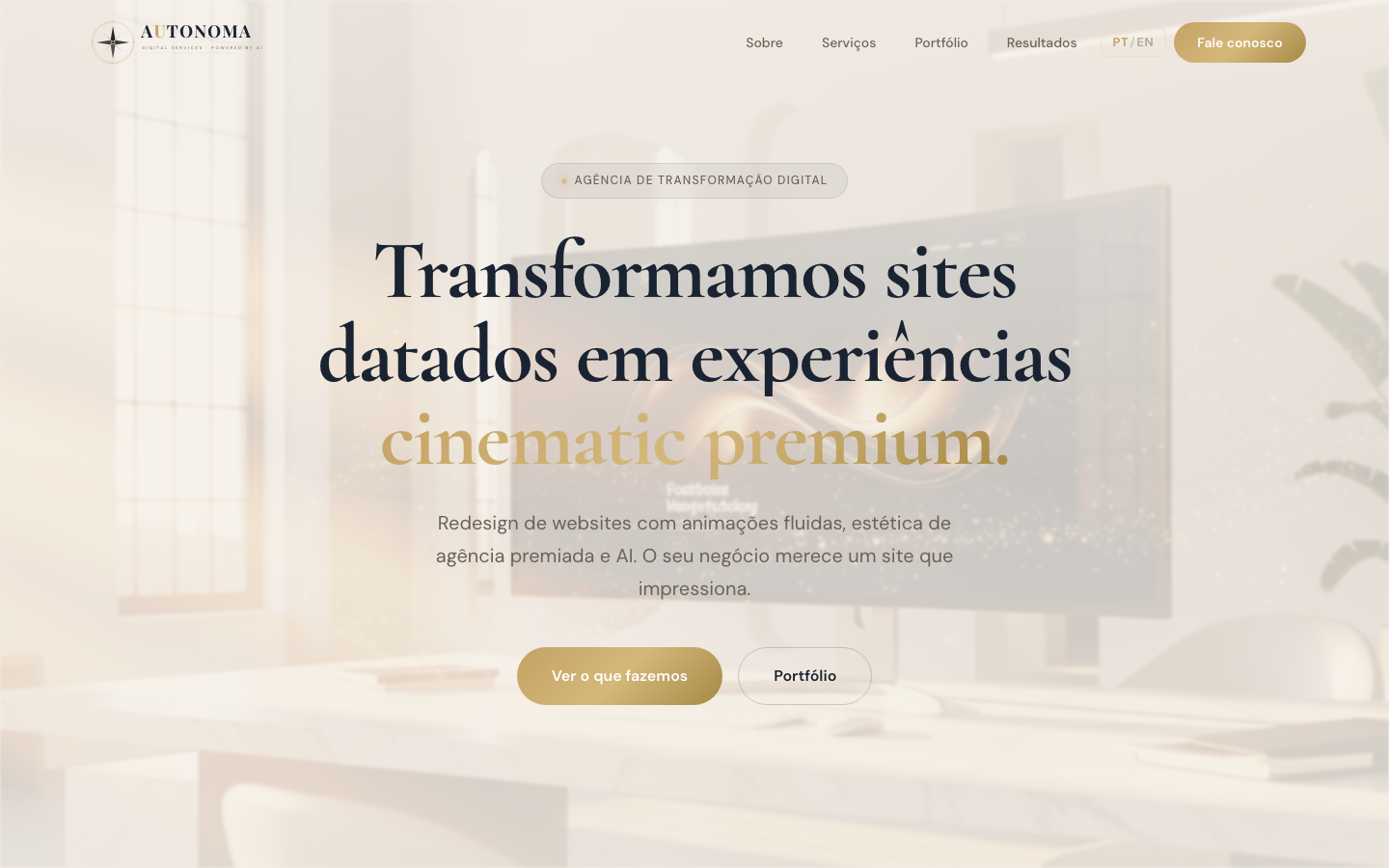
Transformation isn't "adding effects". It's subtracting noise. That's what separates a site a client proudly shares from one they quietly hide. Drag the slider below — it's Autonoma's own site, before and after.
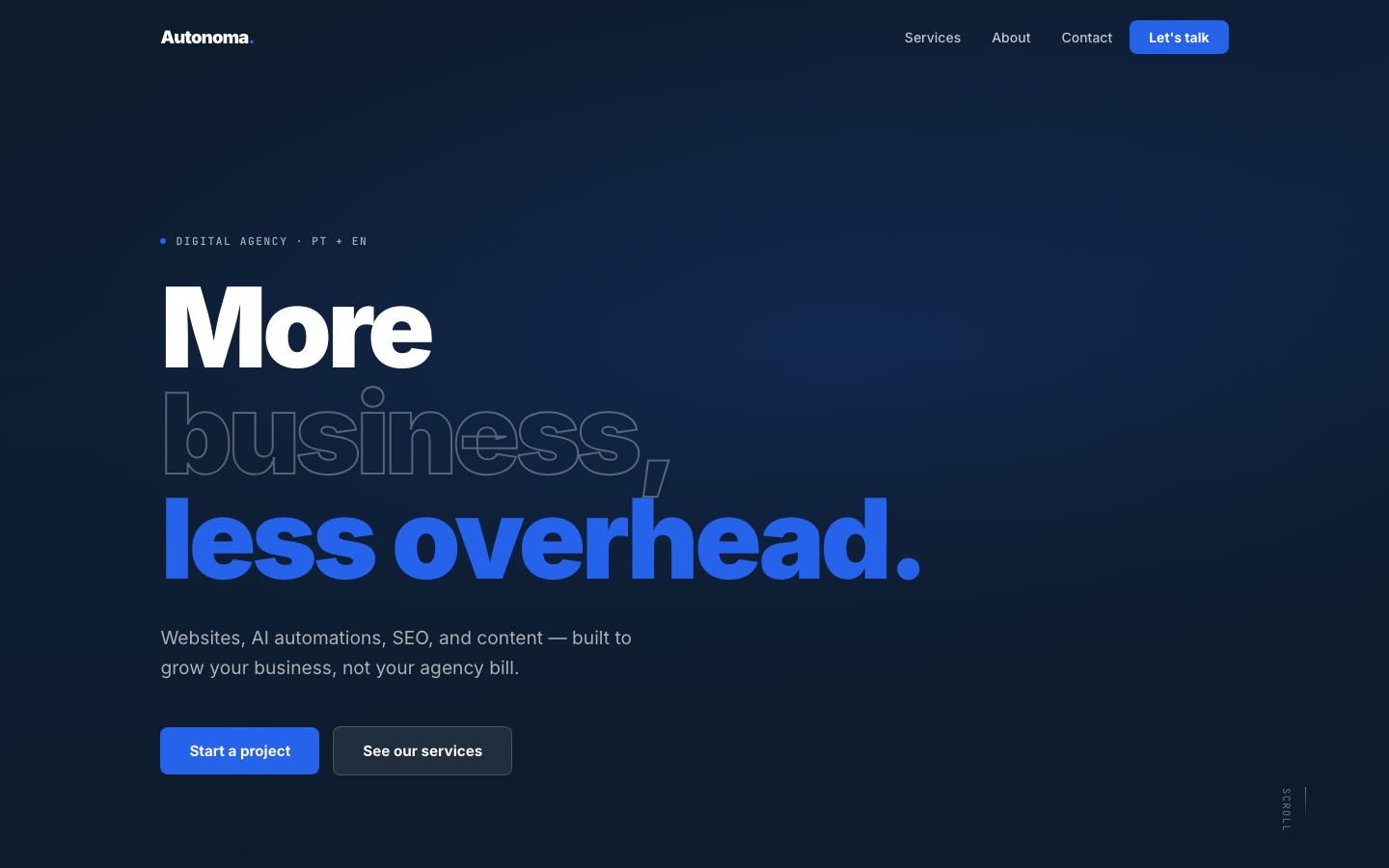
Before: dark template, dense, no breathing room. Generic serif. A lost CTA. A flat hero.
After: space, hierarchy, cinematic video, deliberate typography, motion that respects the reader.
06 · Micro-interactionsThe premium detail.
Micro-interactions are the leather stitching in the expensive car. Invisible until you notice. Memorable once you do.
Hover over the button below. Notice? It pulls the cursor slightly — a behaviour called magnetic cursor. Subtle, but clients mention it.
Other micro-interactions worth the investment
- Text scramble — letters decoding themselves on appearance. Digital, intriguing, memorable.
- Cursor reveal — extra content appears only where the cursor is. Respects space, rewards exploration.
- Hover reveal — additional information emerges on hover. Reduces visual clutter.
- Particle burst — particles exploding on an important click. Celebrates the action.
Each one is small, almost none is mandatory. The cumulative effect is what matters: this site was built with care.
07 · Performance vs. BeautyThe real tension.
Here comes the conflict everyone avoids mentioning.
Everything described above — hero video, GSAP animations, scroll effects — has a performance cost. Google penalises slow sites. Users abandon them.
The trick of a cinematic site done properly isn't avoiding the premium. It's delivering premium without sacrificing performance:
- H.264 MP4 videos with optimised bitrate. 6–8 MB, not 30.
- GSAP is just 27KB. Lighter than most animation frameworks.
preload="metadata"on video.loading="lazy"on below-the-fold images.- CSS
content-visibilityfor off-screen sections. - Fonts with
font-display: swap.
Result: Lighthouse 90+ even with a cinematic experience. It takes work. That's exactly why it's worth it.
08 · What This CostsNo hedging.
A cinematic site made by a traditional agency: €8,000 to €25,000, 3 to 6 months.
A cinematic site made by a lone freelancer with AI: €800 to €2,500, 4 to 8 weeks, highly inconsistent quality.
A cinematic site made by a boutique agency combining AI with human curation — like us — sits between the two, with a consistency and speed neither of the others can reach.
We'll stop short of the full sales pitch. If you want precise numbers and to find out whether it makes sense for your project, talk to us below.